Couples frequently try to work things out on their own. But when they feel that their distance from one another is increasing. They start conversations in an attempt to get back in touch, but these conversations almost always turn into arguments.
Thank you for reading this post, don't forget to subscribe!
One partner feels unheard. The other feels blamed. And before they know it, another wall goes up.
Most couples think the solution is “communicate better”. But the truth? It’s all about learning to listen differently.
That’s where mediation helps.
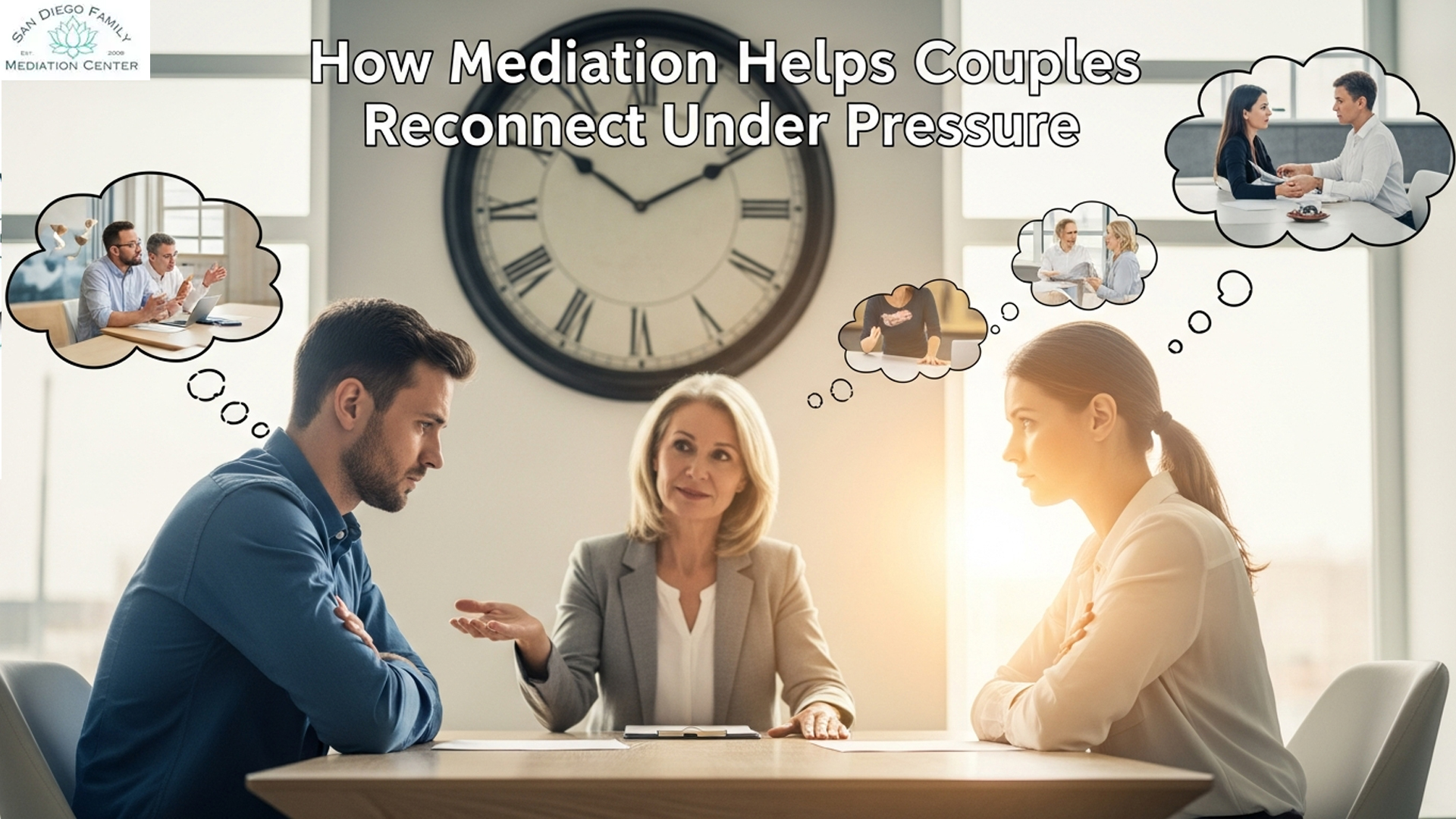
It gives couples the calm space they’ve been missing…a neutral ground to slow down, understand, and rebuild trust without taking sides.
In this guide, we’ll tell you why distance grows between couples, how the mediation process rebuilds connection under pressure, and how its benefits extend far beyond conflict resolution.
Keep Reading!
Why Couples Feel Disconnected (What We Often Hear From Our Clients)
Most couples don’t fall apart overnight. The distance creeps in quietly, through rushed mornings, short texts, and conversations that stop feeling safe.
You don’t notice it at first. Until one day, you realize… you’re sharing a home but not a connection. But Love doesn’t vanish; it just gets buried under your stress and silence.
Here’s what really causes that disconnection and why it hurts so much.
1. The Distraction Problem
Modern relationships often feel overwhelmed. With the demands of work, parenting, and the ceaseless digital chatter, couples frequently find themselves communicating solely about everyday tasks. Conversations revolve around logistics, such as, “Did you take care of that bill?” or “Can you grab the kids?”
Days blend together. Emotional check-ins are replaced by task lists. Over time, both partners start feeling unseen, even while living under the same roof. And when love no longer feels felt, the relationship shifts from partnership to parallel lives.
2. The Miscommunication Loop (Talking Without Understanding)
When disconnection sets in, every small disagreement feels amplified. You try to explain what’s bothering you, but your partner hears blame. They defend themselves, and now you feel unheard.
That’s the miscommunication loop.
Eventually, one partner stops talking to avoid conflict. The other mistakes silence for indifference. And a quiet kind of loneliness settles in that hurts more than arguing ever did.
3. The Emotional Burnout Cycle
Life in San Diego can be beautiful — but it’s also busy. Long workdays, commutes, kids, social pressure… it all piles up. When people are drained, emotional availability disappears. You come home with nothing left to give… no patience, no softness, no curiosity.
And the cycle continues…stress creates distance, distance creates more stress.
4. The Unresolved Conflict Effect
Many couples are disconnected because they don’t resolve what they fight about.
Old arguments linger under the surface. Every new disagreement reopens the same wound. Soon, you find yourself expecting conflict instead of connection. And even when you’re not arguing, you feel tense… waiting for the next explosion.
That constant emotional alertness makes love feel unsafe. So both of you start to retreat behind quiet walls.
5. The Expectation Gap
Disconnection often comes down to different love languages… one needs reassurance, the other needs space; one shows love through action, the other through words.
When those needs go unspoken, they turn into assumptions: “If they loved me, they’d just know.”
But your partner isn’t mind-reading… they’re guessing. And every missed cue feels like rejection.
Disconnection is a sign that communication needs new direction, that emotions need space to breathe, and that both people need to feel heard again.
That’s exactly where a neutral third party helps to rebuild understanding…the first step toward feeling close again.
How Marital Mediation Brings You Back to Each Other (Reconnection Process)
You used to feel close. You could talk for hours, laugh easily, and read each other without words. Now, even simple conversations feel heavy. That loss of emotional closeness hurts more than the arguments themselves.
See how the mediation process bridges that gap in couples, step by step.
1. Rebuilding Emotional Safety
Reconnection starts with safety. When you feel like you’re walking on eggshells, it’s impossible to speak honestly.
The mediator’s role is to create a space where both partners feel protected enough to be real. You can say what you’ve been afraid to say, without fear of it being used against you.
It melts the tension that’s been keeping you apart. It reminds you that you’re both hurting, not enemies. Once safety returns, communication becomes softer, and the relationship starts breathing again.
2. Relearning How to Listen
Most couples think they have a communication problem. But what they really have is a listening problem.
In mediation, you’re guided to slow down your responses… to truly hear, not just prepare your next defense. You start catching what your partner is actually saying beneath the emotion: the need to feel appreciated, considered, or simply loved again.
It’s the kind of listening that makes both people tear up a little, because it’s been a long time since they felt understood.
3. Using Mindfulness to Reconnect
Many couples don’t realize that mediation borrows from the same principles as meditation: presence, awareness, and calm observation.
You have to slow down enough to understand what’s really happening. This mindfulness transforms the energy in the room.
You stop trying to win the conversation. You start trying to connect.
4. Building New Patterns Together
Each mediation session ends with practical commitments: maybe a new boundary, a shared routine, or a simple “no phone time” after dinner.
You begin to laugh again. You reach for each other without hesitation. The distance that once felt impossible starts to fade.
How Mediation Transforms Your Future Relationship
When couples first start mediation, the goal is usually simple: stop fighting. But what most people discover is that mediation doesn’t just stop the noise — it changes how you communicate, long after the sessions are over.
It gives you tools you can carry for life… in your marriage, co-parenting, or even future relationships.
Here’s how:
1. You Build Emotional Intelligence as a Team
Most relationships struggle because both people react from emotion, not awareness.
Mediation slows down those couples’ reactions and names what’s actually happening underneath them.
Instead of saying, “You never listen,” you learn to say, “When I feel unheard, I shut down.”
It’s a skill most couples wish they’d learned years earlier… how to express needs without triggering defensiveness.
And once you both start doing that, the old arguments lose their power.
2. You Strengthen Conflict Navigation Skills
Mediation doesn’t remove conflict; it teaches you how to move through it with grace. Future disagreements still happen, but the tone is different.
You know how to pause when emotions rise. You know when to ask for space. And you know how to return to the conversation with respect, not resentment.
That means even under future pressure like career shifts, parenting stress, financial strain, etc., your communication holds steady.
3. You Create a Shared Vision for the Relationship
Many couples walk into mediation with a list of frustrations. They walk out with a shared understanding of what they actually want.
That might mean setting new priorities, redefining balance, or agreeing on how to handle tough conversations differently. You stop running from problems and start planning for peace.
4. You Protect Your Family’s Emotional Health
For couples with children, mediation leaves a legacy. Kids learn emotional habits by watching how their parents resolve tension. When they see calm discussions instead of shouting matches, it shapes how they’ll communicate as adults.
Even if a relationship transitions into separation, mediation helps protect emotional stability. It replaces bitterness with boundaries and ensures co-parenting stays respectful.
That’s one of the greatest long-term gifts mediation gives…not just peace for you, but peace that echoes into the next generation.
5. You Gain Confidence in Connection
Perhaps the most overlooked benefit of mediation is confidence. You realize you can handle hard things together. You no longer fear conflict, because you’ve learned to navigate it without losing love.
That sense of mastery turns uncertainty into strength. It keeps your relationship adaptable, calm, and connected… even years later.
For San Diego couples juggling careers, kids, and constant pressure, mediation grows relationships stronger, steadier, and more emotionally fluent with time.
Mediation For Couples Help Them To Get Emotional Closeness Again!
At its core, relationship mediation isn’t about fixing what’s broken. It’s about helping couples remember how to see each other again — calmly, clearly, and without all the noise that built up over time.
That’s what makes it different from traditional therapy or self-help advice — mediation gives you structure and peace. It replaces arguments with understanding, and replaces pressure with partnership.
If you’re in San Diego and you’ve tried “talking it out” on your own but keep circling back to the same tension… it might be time to step into a calm, neutral space where reconnection becomes possible again.
Because love doesn’t need to be perfect… it just needs room to breathe.Through structured dialogue, couples ease tension, restore communication, and build emotional intelligence that lasts. If you want fewer fights, deeper trust, and a future relationship built on lasting love… Get a consultation today and explore how mediation can help your relationship.