

You’ve probably heard of the seven-year itch. But the research doesn’t actually back it up. What the data does point to is something a little more unsettling: we may be biologically wired to fall in love every four years. Not “fall out of love” exactly, but cycle — bond, drift, re-evaluate, and maybe start again.
Thank you for reading this post, don't forget to subscribe!
Anthropologist Helen Fisher studied divorce patterns across 58 societies and found a striking peak right around year four. That’s not a cultural quirk. That’s a pattern. So what’s actually going on in our brains and bodies, and what does it mean for your relationship right now?
What the Research Actually Says About the 4-Year Love Cycle
Let’s start with the science, because this isn’t just a pop-psychology theory. Helen Fisher, a biological anthropologist at Rutgers University, spent years analyzing United Nations demographic data on divorce from 58 different cultures.
What she found wasn’t random… divorce rates across wildly different societies all peaked in or around the fourth year of marriage, typically among couples with one young child. That’s remarkable, honestly. It suggests something deeper than culture is at work.
Helen Fisher’s Four-Year Itch: The Anthropology Behind It
Fisher’s theory is rooted in evolutionary biology. For most of human history, a mother nursing a newborn needed a partner nearby, someone to help with food, protection, and shelter. That partnership needed to last about four years, roughly the time it took for a child to become mobile and less dependent. After that? The biological “glue” holding the couple together started to loosen. Fisher called this the “four-year itch”, a natural weak point in our pair bonds that shows up across cultures because it’s baked into our biology, not our belief systems.
Think about that for a second. The urge to move on, to feel that spark somewhere new, isn’t a character flaw. It may be an ancient survival mechanism that’s still running its old code in a world that’s completely changed.
The Brain Chemistry of Falling In and Out of Love
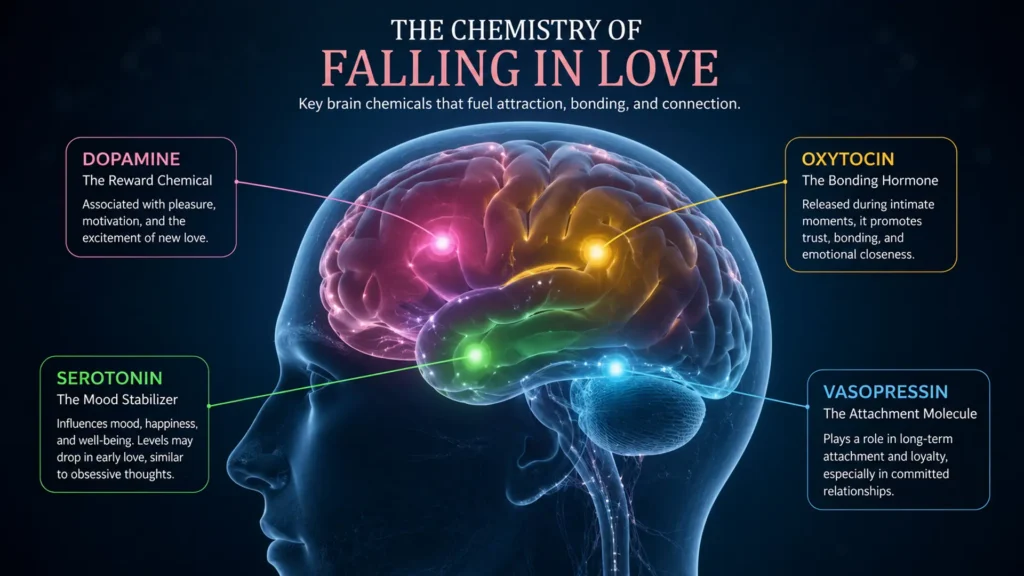
When you first fall for someone, your brain floods with dopamine, that electric, can’t-stop-thinking-about-them feeling. There’s also a surge of norepinephrine (racing heart, sweaty palms, the whole thing) and a drop in serotonin that makes you slightly obsessive. This is lust and romantic love at a neurochemical level.
But dopamine doesn’t last. After roughly three to four years, those levels start to taper. If the relationship has built something real like trust, shared history, deep friendship, oxytocin and vasopressin take over, creating a quieter but powerful sense of attachment and calm. If those bonds haven’t formed? That’s when the cracks start showing. The brain, in a sense, starts “looking around.”
What This Means for Modern Relationships
We live in a world that doesn’t look anything like the African savanna Fisher’s data references. We have birth control, dual incomes, Netflix, and the option to Uber away from a conflict. The biological script is still running, but the context has completely changed. Understanding that there’s a natural weak point around year four doesn’t mean you’re doomed; it means you can see it coming. You can prepare. You can choose.
And honestly? That’s kind of empowering.
If you’re feeling a distance from your partner and wondering whether your relationship can recover its closeness, marriage mediation is one option that helps couples have the honest conversations they’ve been avoiding.
Navigating the Four-Year Itch: What Couples Can Actually Do
Knowing the science is one thing. Knowing what to do with it is another. So let’s talk practically, because this is where most articles drop the ball. They explain the four-year itch and then… leave you hanging.
Recognize the Signs Before the Distance Gets Wide
There’s usually a slow drift before a dramatic rupture. You start keeping score. Conversations feel transactional, logistics, schedules, and who’s picking up the dry cleaning. Physical affection fades from habit rather than a single argument. You start thinking “I love them, but I’m not in love with them”, which, by the way, may just mean the dopamine has leveled off, and the oxytocin hasn’t fully kicked in yet. That’s a biological transition, not a verdict on the relationship.
Some couples misread this natural plateau as incompatibility. And that misread can set off a chain of decisions that are very hard to undo.
Actively Rebuild What Time and Routine Have Quietly Eroded
Here’s something no one tells you: long-term love isn’t a feeling you maintain. It’s a practice you return to, over and over. Novelty drives dopamine. So does shared challenge, laughter, vulnerability, and the feeling that you’re genuinely seen. The couples who make it past year four aren’t necessarily more compatible; they’re more intentional.
That might look like trying something genuinely new together (not just a dinner reservation, but something that creates a real memory). It might mean having a conversation you’ve both been tiptoeing around. It might mean sitting in the same room without your phones for a single hour. These things sound small. They’re not.
When the Drift Feels Too Wide to Bridge Alone
Sometimes the distance has grown to the point where the usual couple’s toolkit, date nights, therapy apps, love languages quizzes, just doesn’t cut it. Not because the relationship is over, but both people are so deep in their own protective patterns that they can’t hear each other clearly anymore.
This is exactly when a neutral third party can make all the difference. Not to take sides. Not to decide the outcome. Just to help you both slow down, say what you actually mean, and hear what your partner is actually saying. That kind of structured conversation can shift something that months of arguing haven’t.
Our team at San Diego Family Mediation Center offers marital mediation specifically for couples at crossroads, whether you’re trying to reconnect or trying to figure out what comes next.
What If You’ve Already Passed the Crossroads?
Not every four-year slump ends with renewal. Sometimes the honest answer is that the relationship has run its course. And that’s a valid, human outcome too, not a failure. Fisher’s research actually supports serial monogamy as a deeply human pattern: bonding deeply, raising a child together, then moving on and potentially bonding again. Millions of people have done exactly that and found genuine happiness on the other side.
If separation feels like the right path, doing it thoughtfully, especially when children are involved, matters enormously. The way you separate shapes everything that comes after: your kids’ wellbeing, your financial stability, your ability to co-parent without hostility. It doesn’t have to be brutal.

The Four-Year Itch Isn’t a Sentence, It’s a Warning Light
Understanding why relationships hit a wall around year four isn’t depressing. It’s actually kind of liberating. It means that the restlessness or distance you’re feeling isn’t necessarily a sign that you picked the wrong person. It might just be your ancient biology running a script that was written for a very different world.
And unlike your ancestors on the savanna, you get to rewrite what happens next. Whether that means choosing to fall back in love with the person you’re with, or navigating a separation with dignity and care, you have more agency than the four-year itch gives you credit for. The key is not ignoring the warning light.
If you’re at a crossroads, whether you want to save your relationship or need guidance through a respectful separation, the team at San Diego Family Mediation Center is here to help. Explore your options with our divorce mediation services in San Diego, or reach out to schedule a confidential consultation today.