

Blended family conflict in San Diego usually comes down to four recurring issues: discipline authority between biological parents and step-parents, money and financial expectations, inheritance and estate planning between children from different marriages, and scheduling friction with the other biological parent’s household.
None of these require a divorce or a lawsuit to resolve. What they require is a structured conversation where everyone’s actual concerns get addressed directly, which is exactly what mediation is built for.
4 Conflicts That Bring Blended Families to Mediation
Blended families aren’t in crisis when they come to us. Most of the time, they’re a genuinely functioning household that keeps running into the same few friction points, over and over, without a clear way to resolve them. Therapy can help process the emotions underneath those conflicts.
Mediation is different: it’s focused on producing an actual working agreement everyone can point back to, so the same argument doesn’t have to happen again next month.
Discipline Authority: Where Step-Parents and Bio-Parents Clash Most
This is the single most common issue we see. A step-parent sets a boundary, a bio-parent overrides it, and the kids learn quickly which adult’s word actually carries weight in the house. Neither person is necessarily wrong. The bio-parent often feels protective of a relationship they don’t want damaged, and the step-parent often feels undermined in a home they’re supposed to be an equal part of running. Left unaddressed, this tends to get worse, not better, because every unresolved incident becomes ammunition for the next one.
In mediation, we help the household define specific discipline authority in specific situations, rather than leaving it as a vague, ongoing negotiation. Who handles homework enforcement. Who has final say on screen time. What happens when the bio-parent isn’t home and a decision needs to be made in the moment. Getting this in writing, even informally, gives both adults something concrete to refer back to instead of relitigating the same disagreement every time it comes up.
A pattern we see often: a step-parent enforces a bedtime or a screen time limit, the child complains to their biological parent, and the bio-parent softens or overrides the rule without realizing how often this has been happening. Neither adult set out to undermine the other. It just accumulates, one small override at a time, until the step-parent stops enforcing anything at all because it never sticks. Naming this pattern out loud in mediation, and agreeing on a specific handful of situations where the step-parent’s decision is final, tends to fix it faster than most families expect, because it’s rarely about the actual rule. It’s about knowing the decision will hold.
Money, Inheritance, and Whose Kid Gets What
Financial friction in blended families usually shows up in two forms: day-to-day spending disagreements (whose kid’s activities get funded, how household expenses get split when incomes are uneven) and longer-term estate concerns, especially once one spouse starts wondering whether their biological children will actually inherit fairly if something happens to them.
That second concern often goes unspoken for years, quietly shaping how someone behaves in the marriage, until it finally surfaces as resentment neither spouse fully understands the root of.
Mediation gives both of these a direct outlet. For day-to-day finances, we help couples build a framework, not just a one-time agreement, so new situations (a kid’s college fund, an unexpected medical bill) have a clear process instead of becoming a fresh negotiation every time.
For inheritance and estate concerns, we help both spouses say the quiet part out loud in a structured setting, and work toward an approach, whether that’s separate provisions for each spouse’s biological children or a shared plan both of you actually agree to, that reflects what you both genuinely want rather than what either of you assumed the other expected.
Coordinating Schedules With the Other Household
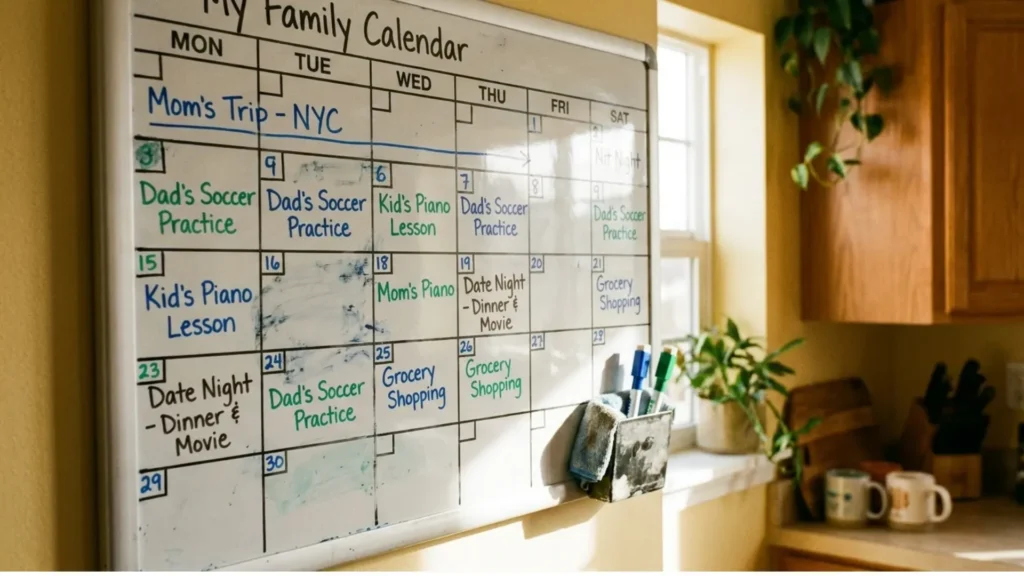
The fourth recurring issue isn’t between the spouses in the blended household at all. It’s between the blended household and a biological parent living somewhere else, often another part of San Diego County, and the friction usually centers on holidays, vacations, and how activities get scheduled when a kid is splitting time between two households with two very different sets of routines.
A step-parent’s family event lands on the same weekend as the other parent’s holiday time. A new sibling’s birthday conflicts with an existing custody exchange. None of these are anyone’s fault, but they pile up fast without a shared framework.
This is a slightly different kind of mediation than the first two, because it usually involves more than two people at the table, sometimes both biological parents and a step-parent, working out a schedule everyone can actually plan around a year in advance instead of renegotiating every holiday individually. Getting this settled tends to remove a surprising amount of tension from the blended household itself, since a lot of the discipline and financial friction we see actually gets worse in the weeks surrounding a scheduling conflict with the other house, not independently of it.

Mediation vs. Family Therapy: Which One Actually Fixes Your Specific Problem
A lot of blended families hesitate to reach out because they assume this kind of issue belongs in a therapist’s office, not a mediator’s. Sometimes that’s true. If the core problem is emotional, unresolved grief from a previous marriage, a step-child struggling to adjust, communication patterns that keep breaking down regardless of the topic, therapy is the right tool, and we’ll tell you that directly rather than take on a case we’re not the right fit for.
But if the conflict is really about a specific, recurring decision that keeps not getting resolved (discipline rules, money, inheritance, holiday schedules with the other household), that’s a structural problem, not primarily an emotional one, and mediation is built specifically to produce the kind of concrete agreement that fixes it.
Many of the blended families we work with are also in therapy, and the two aren’t in competition. Therapy helps you process how you feel about the conflict. Mediation helps you actually resolve it, in writing, so it stops being a recurring conflict in the first place.
A simple way to tell which one you need: if you had a written agreement covering the specific issue tomorrow, would the underlying conflict actually resolve? If yes, that’s a mediation problem. If the answer is that you’d probably still be upset or disconnected even with an agreement in hand, because the real issue is how you communicate or how a family member has adjusted emotionally to the new household, that’s worth bringing to a therapist first, or alongside mediation rather than instead of it. We’d rather point you toward the right resource than take on a case where mediation isn’t going to actually solve what’s bothering your family.
If you recognize your family in any of this, our blended family mediation service is built specifically for step-family dynamics, not general divorce mediation repurposed for a different situation. We also work with families navigating estate and inheritance concerns that overlap with blended family planning, since the two issues are connected more often than people expect.
Want To Protect Your Blended Family From Repeated Conflicts?
Blended family conflict tends to circle back to the same few issues: who has authority in the house, how money gets handled, what happens to what you leave behind, and how two households coordinate around the same kids. None of that requires a courtroom, and most of it doesn’t require ending a marriage either. What it requires is a structured place to work it out, with someone neutral making sure both perspectives actually get heard and the agreement you leave with is one you’ll both actually follow.
If your blended family keeps running into the same conflict without a real resolution, schedule a free consultation with our team. We’ll help you figure out whether mediation, therapy, or both is the right next step for your specific situation.